Books That Make an ImpressionEvery Time They're Opened
From polished softcover business books to premium hardcovers with specialty cover materials, we help you produce printed books that look professional and hold up to real use. Whether you need 25 copies or 2,500, we'll help you find the right format, binding, and finish for your project.
CLIENT RETENTION RATE
YEARS OF BOOK PRINTING
COVER TYPES: SOFT & HARD
BINDING OPTIONS
A Partner Who Knows Books from Cover to Cover
Book printing involves more decisions than most print projects — page count, binding, cover material, run quantity, paper stock. We've been walking customers through every one of those decisions for over two decades. Our job is to make sure you get a book that does exactly what you need it to do.
Expert Guidance, Start to Finish
You get a dedicated contact who knows book production — not a call center. We'll help you make smart decisions on binding, paper, and quantity so you don't overpay or under-produce.
Short Runs Welcome
You don't need to order thousands to get quality results. We regularly handle small-quantity orders for test markets, limited editions, and organization-specific publications.
Proof Before You Print
Every book order includes a review step before production begins. We'll flag file issues and you'll approve the proof, so there are no surprises when your copies arrive.
Soft & Hard Cover Options
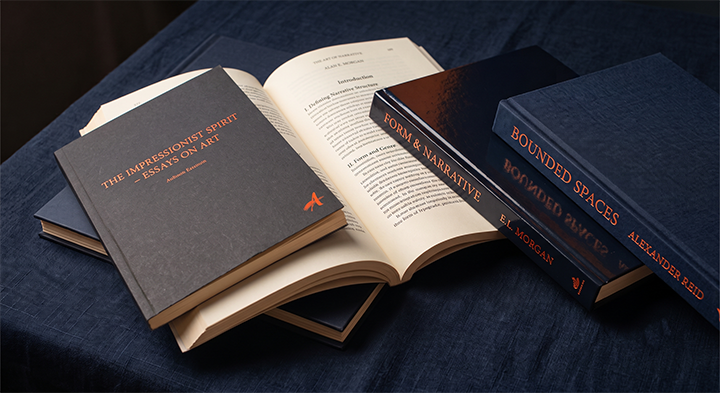
We produce both softcover and hardcover books — including specialty cover materials like linen and leatherette — so your format can match your audience and purpose.
Softcover Books
Flexible, cost-effective, and faster to produce — the go-to choice for most business and organizational publications.
Perfect Binding
The most common softcover format. Pages are gathered, trimmed, and glued to the spine with a flexible adhesive, creating a clean flat spine. Looks polished on a shelf and reads naturally in hand.
BEST for:
- Business Books
- Novels
- Corporate Reports
- Training Guides
Spiral / Coil Binding
A wire or plastic coil is wound through punched holes along the edge of the pages. The book lays completely flat when open, making it easy to write in or refer to without holding it down.
BEST for:
- Workbooks
- Training Manuals
- Reference Guides
- Recipe Books
- Planners
Saddle Stitch
Sheets are folded and stapled through the spine. The most economical option for lower page counts, with a clean finished look. Typically works best when the total page count is under 64 pages.
BEST for:
- Short Booklets
- Program Books
- Mini Catalogs
- Event Publications
Hardcover Books
Built for durability, display, and lasting impact. Two distinct cover styles — choose the finish that fits your publication.
Laminated Hard Cover
A printed wrap covers the boards, finished with a gloss or matte laminate for a clean, durable surface.
✳️ Full-color design printed directly on the cover wrap — photos, graphics, and typography all possible
✳️ Gloss laminate for a vibrant, photo-friendly look; matte for a softer, more refined feel
✳️ The most common hardcover format; widely recognized as a "standard hardcover"
✳️ Suitable for business books, photo books, trade publications, and children's books
✳️ Binding options: adhesive case binding (standard) or Smyth sewn (premium, recommended for 400+ pages
Specialty Cover Materials
Linen, leatherette, or other textured materials applied to the boards for a distinctive, tactile finish.
➡️ Cover text and imagery are typically applied via foil stamping or debossing — no printed ink wrap
➡️ Linen offers a classic, textured appearance ideal for commemorative and literary publications
➡️ Leatherette provides a premium, professional look suited to corporate gifts and limited editions
➡️ Ideal when the physical object itself is part of the message — these books feel as special as they look
➡️ Binding options: adhesive case binding or Smyth sewn depending on page count and use
Choosing the Right Binding
Every binding method has a purpose. Here's a quick comparison to help narrow it down.
Binding Type
Cover
Lays Flat?
Best Page Count
Typical Use
Option 1
Perfect Binding
Softcover
Partially
80-800 pages
Novels, business books, corporate reports
Option 2
Spiral / Coil
Softcover
Yes
Any count
Workbooks, manuals, training materials
Option 3
Saddle Stitch
Softcover
Yes
Up to ~64 pages*
*the actual page count that fits may vary depending on paper thickness.
Short booklets, programs, mini catalogs
Option 4
Adhesive Case Bound
Hardcover
Partially
48-400 pages
Standard hardcovers, business books
Option 5
Smyth Sewn
Hardcover
Yes
96+ pages
Premium, coffee table, long-use reference
Binding Type
Cover
Lays Flat?
Best Page Count
Typical Use
Option 1
Perfect Binding
Option 2
Spiral / Coil
Option 3
Saddle Stitch
Option 4
Adhesive Case Bound
Option 5
Smyth Sewn
Option 1
Softcover
Option 2
Softcover
Option 3
Softcover
Option 4
Hardcover
Option 5
Hardcover
Option 1
Partially
Option 2
Yes
Option 3
Yes
Option 4
Partially
Option 5
Yes
Option 1
80-800 pages
Option 2
Any count
Option 3
Up to ~64 pages*
*the actual page count that fits may vary depending on paper thickness.
Option 4
48-400 pages
Option 5
96+ pages
Option 1
Novels, business books, corporate reports
Option 2
Workbooks, manuals, training materials
Option 3
Short booklets, programs, mini catalogs
Option 4
Standard hardcovers, business books
Option 5
Premium, coffee table, long-use reference
What Kind of Book Are You Printing?
Books serve many different purposes. Here are some of the most common types we produce for businesses, organizations, and authors.

Business & Leadership Books
Cookbooks & Recipe Collections

Children's Books
Training Manuals & Workbooks
Church & Ministry Publications
Commemorative & Gift Books

Annual Reports & Portfolios

Self-Published Books
From Manuscript to Front Door
Book printing involves more steps than a typical print job, but we keep the process straightforward. Here's what to expect from start to finish.

Get a Quote
Tell us your specs - cover type, binding, page count, size, and quantity. We'll work through the options and give you an accurate quote.
Prepare Your Files
We'll let you know exactly what file format we need for your interior pages and cover. If you need design help, we can connect you with our design team.
Review Your Proof
We'll check your files for common issues and send you a proof for approval before anything goes to press. No surprises.

Print & Bind
Once you approve the proof, we produce your books. Softcovers typically complete faster than hardcovers - we'll give you a timeline at the quote stage.
What Our customers are saying
"We have been working with Integra since 2019, and our business depends on all the great individuals there. They are indispensable to any size business looking to elevate its marketing material and presence."
Marshall Kramer
"Integra is one of our largest and most dependable vendors. They work closely with us and have a problem-solving and customer service-based mindset. Very grateful to work with the Integra team!"
Emily Martin
"The team at Integra Graphics goes above and beyond in terms of the level of service they provide and the quality of print and mail products and processes. I can trust them to take ownership of the project from begining to full completion and have nothing but positive things to say about working with them."
Chris Taft
Short run or long run?
Short-run printing (typically under a few hundred copies) is handled digitally - it's flexible, faster to set up, and cost-effective at lower quantities. Long-run printing uses offset presses and lowers the per-unit price significantly at higher quantities. We can help you determine which approach makes sense for your project and budget.
Book Printing Questions, Answered Plainly
What's the difference between softcover and hardcover books?
Softcover books (also called paperbacks) have a flexible cover that sits flush with the page edges. They're lighter, more portable, and less expensive to produce. Hardcover books have rigid boards that extend slightly past the page edges, making them more durable and visually substantial. The right choice depends on how you want the book to feel, how long you want it to last, and what your budget allows.
What binding is best for a book people will write in or refer to frequently?
Spiral or coil binding is the best fit for workbooks, training manuals, and anything someone needs to flip open and hold flat while they're working. The coil allows the book to lay completely flat — or even fold back on itself — so the pages don't fight you. Smyth-sewn hardcovers also lay flat and are a great choice if you want durability alongside that feature.
What's the minimum page count for a softcover or hardcover book?
For perfect-bound softcovers, you need enough thickness at the spine for the glue to hold — roughly 1/8" or more, which often works out to around 64 pages depending on your paper stock. Thicker paper reaches that threshold with fewer pages. Hardcovers typically require at least 48 pages for the binding to work properly. If your page count is lower, we can discuss saddle stitch or comb binding as alternatives, or look at paper choices that add thickness.
What's the difference between a laminated hard cover and a specialty material hard cover?
A laminated hard cover uses a printed paper wrap over the boards, finished with a clear laminate (gloss or matte). You get full-color printing on the cover — photos, graphics, and text all work great. A specialty material cover replaces that printed wrap with a textured material like linen or leatherette. The cover is then personalized with foil stamping or debossing rather than ink printing. The result feels more like a handcrafted object — ideal for commemorative books, corporate gifts, or premium limited editions.
Can I print a small quantity — say, 25 or 50 books?
Yes. We handle short-run book printing regularly. The tradeoff is that smaller quantities cost more per unit because setup and make-ready work is spread across fewer copies. But it's a completely reasonable approach for test markets, limited distributions, or projects where you genuinely only need a modest supply. We'll give you an honest unit cost at the quote stage so you can make the call.
How long does book printing take?
Can I get full-color interior pages?
Yes. Both black-and-white and full-color interior pages are available. Color interior printing costs more, so many customers choose it selectively — for example, color photography sections with black-and-white text pages, or full color throughout for children's books and coffee table books. We'll help you think through where color adds the most value for your specific project.
What file format do I need to submit?
Print-ready PDF files are standard. You'll need a separate file for the interior pages and the cover (or cover wrap, for hardcovers). We'll walk you through the specific requirements — things like bleed size, resolution, and color mode — when we get into the production details. If your files aren't print-ready, our design team can help get them there.
Ready to Get Your Book Printed?
Whether yopu know exactly what you need or you're still figuring out the details, we're happy to talk through your project. Tell us what you're working on and we'll help you get there.