


If you're reading this, you've probably already lived the problem.
Somebody on your team knows exactly where the welcome kits are stored. Somebody else is the one who remembers to reorder the folders before they run out. And when either of them is out sick or moves on, the whole system stalls until someone digs through a supply closet to figure out what's actually on hand.
That's usually the moment a company starts searching for a fulfillment partner instead of treating a filing cabinet like a warehouse. If you're in that search right now—not the "what is fulfillment" version of it, but the part where you're actually comparing vendors and trying to figure out which one will still be a good decision a year from now—this article is for you.
We work with fulfillment every day at Integra Print & Promo, and we've seen what separates a real partner from a warehouse with a website. Here's what actually matters when you're making this decision.
The real job a fulfillment partner does
Strip away the marketing language and fulfillment comes down to four foundational things: storing your printed materials and promotional items, picking and packing them accurately when an order comes in, shipping them wherever they need to go, and giving your team a way to order without calling you every time.
That last piece is the one companies underestimate going in. A warehouse that stores boxes and ships them when you send an email is fine for occasional, one-off needs. But if more than one person or more than one location needs to order the same materials—which is almost always the case as companies grow—you need an ordering system behind the warehouse, not just a shelf and a phone number.
Sign #1: your staff time is being eaten by inventory management
A few patterns show up again and again in companies that eventually decide to bring in a fulfillment partner. The first one is the most telling: staff time is going toward sorting boxes, counting inventory, and repacking shipments instead of their actual job.
When your marketing manager is spending Tuesday morning hunting for the right promotional items, or your HR team is boxing up new hire kits instead of onboarding people, that's not a storage problem. It's a bandwidth problem. And bandwidth—real employee hours—costs far more than outsourcing ever will.

Sign #2: growth is creating chaos, not efficiency
Every new hire, new location, or new event means somebody hunting down the same ten items and hoping nothing's missing. That works at a certain scale. Once you hit three or four locations, or you're running multiple concurrent events, the manual system breaks down.
What usually breaks it is inconsistency. Different locations end up with slightly different versions of the same kit because nothing is centralized. One office gets a branded folder, another gets an unbranded one. Marketing knows the logo changed six months ago, but the warehouse didn't. Nobody notices a reorder is needed until the shelf is already empty and you're paying rush shipping to fix it.
If two or three of these sound familiar, you're not being dramatic. That's the actual threshold where outsourcing starts paying for itself in time, not just dollars.
Sign #3: you're bulk printing to save money, then throwing it away
Here's a painful pattern: materials get printed in bulk to save money on production, then go stale in a closet and get thrown out anyway when the design changes or the event ends.
A fulfillment partner can help you avoid this. Instead of guessing at quantities and tying up cash in inventory that might go unused, you can print what you actually need, store it, and let demand tell you when to reorder. That shift alone recovers a lot of the cost of the service.
Sign #4: nobody has visibility into what's actually available
You can't manage what you can't see. When inventory sits in different locations, or different people are ordering the same items without coordination, you lose visibility. Finance can't tell where the budget went. Operations can't tell what's on the shelf. Your team can't tell if something is in stock before they promise it to a customer.
A fulfillment partner should give you real-time visibility into what's actually available, not a guess or a phone call away.
The storefront question most buyers forget to ask
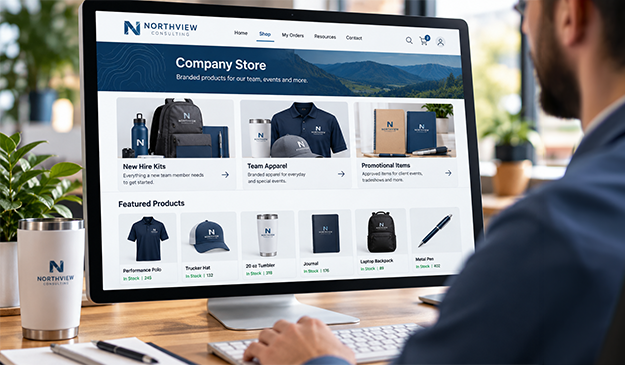
Here's the part that separates a real fulfillment partner from a warehouse that happens to ship things: can your team actually order on their own, or does every request still have to go through you?
A private ordering storefront solves this, and it's worth understanding what a good one actually includes before you compare vendors:
Approved users, approved items. Your team logs into a site built for your company, not a shared marketplace. Only the people you approve can order, and they only see the items you've made available to them. This keeps brands consistent and prevents accidental mistakes.
Personalization within guardrails. A location might need its own address on a mailer or its own name on a sign, but the logo, colors, and layout stay locked. Nobody accidentally orders an off-brand version of anything.
Kits, not line items. A new hire doesn't need to know they're ordering a shirt, a folder, and a mug separately. They click "new hire kit" and it ships as one complete package. This removes complexity and human error.
Inventory visibility. You should be able to see stock levels without calling anyone, and ideally get a heads-up before something runs out rather than after. Real-time inventory data beats surprises every time.
Reporting that matches how your company is organized. Orders broken out by location, department, or cost center, so finance can track spend accurately and you can see patterns in what's actually being used.
None of this requires reinventing how your team buys things. It requires a partner who's built the ordering experience around your company specifically, instead of handing you a generic portal and calling it done.
Questions worth asking before you sign anything
A lot of fulfillment comparisons stop at "how much does storage cost," which tells you almost nothing about how the relationship will actually feel six months in. These questions get much closer to the truth:
What happens when a kit is wrong? Every fulfillment operation eventually makes a mistake. The honest answer isn't "we never do"—it's how errors get caught, who tells you, and what happens next. A partner who proactively catches their own mistakes is different from one who waits for you to complain.
Who do you call when something's urgent? A dedicated account contact is a fundamentally different experience than a ticket queue that closes at 5 p.m. Ask what happens outside normal hours if a shipment absolutely has to go out.
Can you store items you didn't produce? Some partners only warehouse what they printed. If you've got promotional products or other materials from elsewhere, ask directly whether those can sit on the same shelf and ship in the same kit. This matters more than you'd think if you're buying from multiple vendors.
How does reordering actually work? Some version of "we'll let you know when you're low" is table stakes at this point. Ask what that notification actually looks like, how much lead time it gives you, and whether you can customize reorder thresholds by item.
What's included in the quote, and what isn't? Storage, pick-and-pack, kitting, and shipping are sometimes bundled and sometimes priced separately. A lower number on one line can hide a higher total once everything's added up. Ask for the full picture, not just the headline rate.
Is this a side service or a core operation? Some printers added fulfillment as an afterthought. Others built it as a central part of how they work. You can usually tell the difference by how specific their answers are to the questions above. A real operation has thought through the details because they live them every day.
Why printing and fulfillment under one roof actually reduces risk
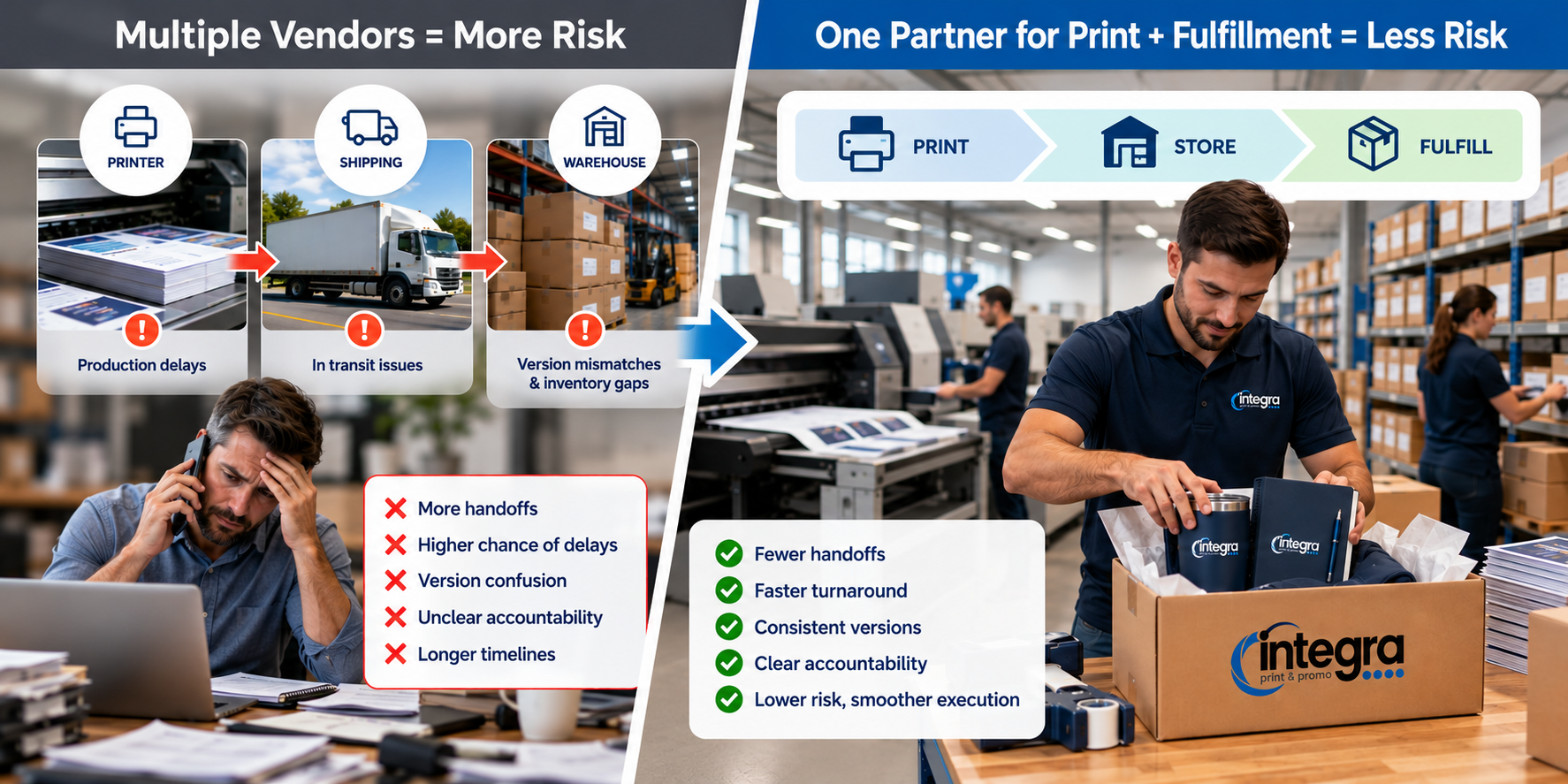
There's a practical argument for working with a partner who handles both the printing and the fulfillment, beyond just convenience.
Every handoff between vendors is a place where something can go wrong—a shipment delayed in transit between the printer and the warehouse, a version mismatch because two companies weren't coordinating, a reorder that takes an extra week because it has to route through a second business before reaching the first.
When one partner produces the materials and stores them, a low shelf turns into a reprint instead of a phone call to someone else, a wait, and a shipment to receive and reshelve. It's a smaller thing than it sounds like, until you're the one waiting on a kit that has to pass through three different companies to get to one event.
You also get better accountability. When something goes wrong, you know exactly who to call. There's no finger-pointing between the printer and the warehouse about who caused the delay. That clarity matters more operationally than most people expect.
What to expect from a partner who's actively growing
If you're evaluating a fulfillment partner who's recently added or expanded their operation, that's not automatically a red flag. New capacity gets built to match real demand, and a partner who's scaling intentionally—bringing on the right storage infrastructure, the right ordering system, the right team—is often a better bet than one who's been running the same setup for a decade without updating any of it.
Ask what they're building toward and whether their plans match where your company is headed, not just where it is today. A partner with growth plans is one you can grow with.
The questions you haven't thought to ask yet
What is fulfillment, really? It's the combination of storing your printed materials and promotional products, then picking, packing, and shipping them on demand, whenever an order comes in.
How is fulfillment different from a mailing house? Mailing sends printed pieces to a list through the postal system on a schedule. Fulfillment ships boxes and kits to people or locations as they're requested, on demand.
Do I need a storefront if I only have one location? Not necessarily, but if more than one person places orders, or you expect to add locations later, setting one up early is easier than retrofitting it after your team is already used to emailing requests.
What should I have ready before asking for a quote? A rough sense of what's being stored, how many items go into each kit, how often orders go out, and where they're shipping. Exact numbers aren't required to start the conversation.
Can a fulfillment partner scale with my company? A partner actively investing in storage capacity and ordering technology, rather than running on fixed infrastructure, can usually scale with you. It's a fair question to ask directly.
Frequently Asked Questions
Q: When should we move to a fulfillment partner instead of managing fulfillment in-house?
A: Once your company reaches 3–4 locations, multiple concurrent events, or you have more than one person ordering supplies regularly, managing inventory in-house usually stops working. The real trigger is when your staff is spending hours on box shuffling instead of their jobs, or you're losing consistency across locations. At that scale, outsourcing fulfillment pays for itself in recovered employee time, not just dollars.
Q: What's the difference between a fulfillment partner and just a warehouse with a website?
A: The core difference is in the systems and relationship. A fulfillment partner gives your team an ordering system where they can reorder independently, provides real-time visibility into inventory, proactively catches mistakes, and thinks about how to scale with your growth. A basic warehouse stores boxes and ships them when you contact someone. One is infrastructure for your business; the other is just storage.
Q: What should we budget for fulfillment services?
A: Costs typically include storage (per pallet or per cubic foot), pick-and-pack fees (per order or item), kitting services, and shipping. The key is getting a complete quote that shows all of these, not just a headline rate. A good partner will tie pricing to your actual usage patterns—how much is stored, how many items go into each kit, and how often orders go out. Compare total cost across vendors, not individual line items.
Q: Can a fulfillment partner store items we didn't have them print?
A: It depends on the partner. Some only warehouse materials they've printed. Others are set up to store and ship items from multiple vendors—promotional products, branded gear, materials from other suppliers—all in the same kit from the same shelf. Ask directly about this if you're working with multiple vendors.
Q: Will a fulfillment partner be able to scale with our company?
A: Ask what they're actively investing in: Are they expanding storage infrastructure? Upgrading their ordering systems? Bringing on staff to handle growth? A partner who's intentionally building for scale, rather than running the same setup for years without changes, is usually a better bet long-term. Their growth trajectory should match or exceed where you're headed.
---
Here's what comes next
The decision to bring in a fulfillment partner is operational, not just a vendor selection. It touches how your team works, how your orders flow, how your budget gets tracked, and what you're able to promise to your own customers.
The right partner isn't the one with the lowest rate. It's the one who understands your business specifically, who's built systems around the way you actually work, and who invests in the relationship rather than just processing transactions.
Your next step is concrete: Visit our fulfillment and storefront services page to see how we handle storage, pick-and-pack, kitting, and ordering. Tell us what you're trying to solve—growth, consistency, visibility, or all of the above. We'll tell you whether fulfillment is the right move and what it actually looks like for your company.
At Integra Print & Promo, we don't just store your materials. We become the infrastructure your growing team needs. That's what "Your Project. Our Passion. One Trusted Partner." really means.

Topics:
